



 மாணவர் முரசு
 இ-பேப்பர்



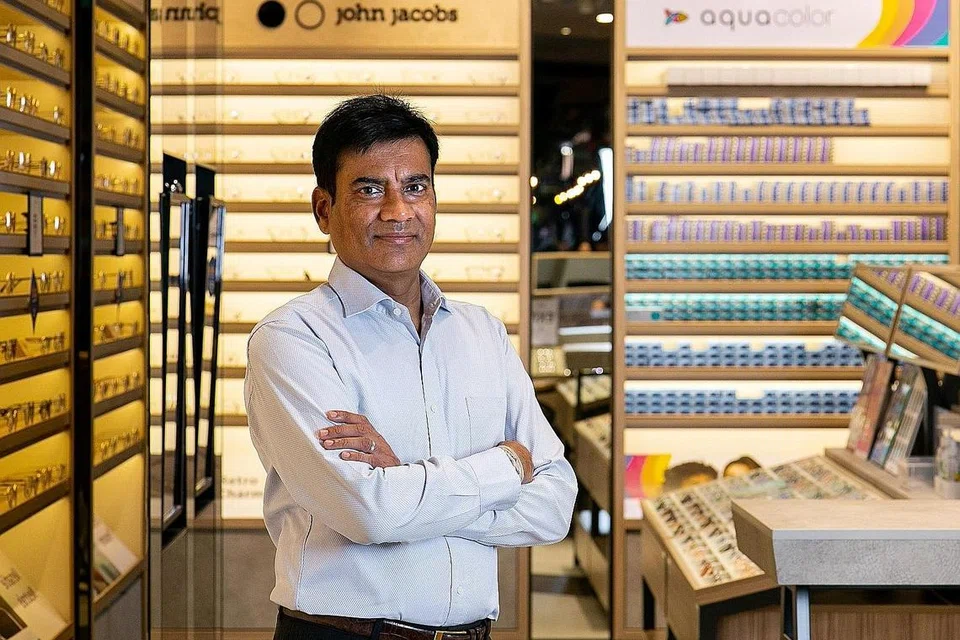
As the optical industry goes digital to meet growing customer expectations, India-headquartered eyewear company Lenskart is tackling the e-commerce challenge head-on via the use of technology.
Using 3D augmented reality (AR) technology, shoppers can try on Lenskart's eyewear virtually from the comfort of their homes.
Mr Anantha Nayak, Lenskart's chief business officer for South-east Asia, said that the omnichannel eyewear player has "completely transformed" the shopping experience for Singaporean consumers: "We have completely disrupted the technology space and the online platform."
The AR try-on option is offered on Lenskart's website.
Shoppers simply use the front-facing camera of their device and make simple head rotations for the technology to recognise their facial features.
The platform then recommends specific eyewear from over a thousand options on its database, allowing shoppers to compare how different models suit their face.
The eyewear player prides itself on its dual-channel business model, with both physical retail and e-commerce.
Since its entry into Singapore in 2019, Lenskart has set up 20 stores on the island, with its latest outlet at VivoCity opening on Nov 9 last year.
It is aiming to hit 30 stores by March this year.
Lenskart currently employs more than 200 people in Singapore, with plans to employ about 100 more staff this year, Mr Nayak said.
Last year, the company launched its mobile application in Singapore.
Available for both iOS and Android users, the app has seen over 10 million downloads.
Even with the immense competition in the online space, Mr Nayak is confident that Lenskart's offerings are competitive as it specifically curates for the Asian market, compared to overseas sellers.
Lenskart also owns its entire supply chain end-to-end, which helps to "ensure very high quality of products and very affordable pricing", he added: "In the optical industry, the pricing is very high simply because there are too many middlemen. At Lenskart, we cut out the middleman."
The company owns manufacturing plants in India and China and has its own lab in Kaki Bukit for edging, the process in which specific lenses are precisely cut to fit a frame.
At a small retail shop, the edging process can be done only on a small scale, but in a lab, hundreds of lenses can be processed on the same day, leading to efficiency, pointed out Mr Nayak.
Lenskart spectacles range from $148 for two pairs to $248 for two pairs. During discount sales online, prices even go as low as $68 for two pairs. But to enjoy such one-for-one offers, a customer has to acquire the Lenskart Gold Membership.
This loyalty programme costs $30, but its benefits can be used any number of times throughout the year.
Lenskart also has a "strong" design team, said Mr Nayak, which constantly creates new product offerings that suit consumer tastes at different time periods. These include unique Japanese, Korean and Italian collections.
"Any store that you go to, (you would see that) we appeal to the younger target audience, and they want the latest trends," Mr Nayak noted.
To address the growing issue of eye care, Lenskart offers free eye testing services, even if consumers decide not to purchase from it eventually.
"We genuinely believe everybody has to have a right to free eye testing, and that is not a service we want to charge for," said Mr Nayak.
On Dec 16, Lenskart unveiled plans to expand its network of physical stores across South-east Asia to more than 75 this year.
It also intends to enter the Indonesia and Vietnam markets by March.
Announcing the expansion, Mr Nayak said: "We are eagerly looking forward to serving more consumers across the region with better quality products and the most advanced eyewear solutions."
Founded by Indian entrepreneur Peyush Bansal in 2010, the eyewear start-up expects to be valued at US$5 billion ($6.8 billion), once a US$250 million funding round led by Softbank is closed.
svenga@sph.com.sg
"In the optical industry, the pricing is very high simply because there are too many middlemen. At Lenskart, we cut out the middleman."
- Mr Anantha Nayak (left) Lenskart's chief business officer for South-east Asia